What is adenomyosis?
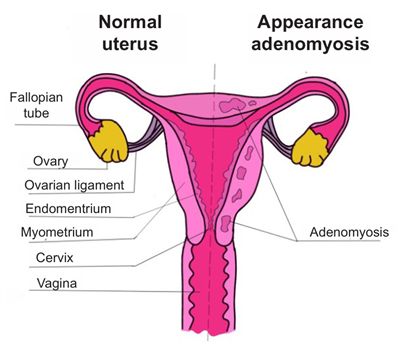
Adenomyosis is a common gynaecological problem where the lining of the womb (endometrium) lies within the muscle layer of the womb (myometrium).
Adenomyosis affects one in ten women and can affect women of any age; however, it is most common in women aged 40-50 and in women who had children. It is a benign condition (not cancerous). It is also found with patients who have endometriosis.
What is the cause?
The cause is unknown; however, there are several theories. Hormones, genes and your immune system may also have a part to play in the development of adenomyosis.
What are the signs and symptoms?
The most common symptoms are heavy and painful periods which can then lead to anaemia and associated symptoms of tiredness and dizziness. Women may also experience pre menstrual pelvic pain and feelings of heaviness/discomfort in the pelvis.
Less common symptom include pain during sexual intercourse and miscarriages.
Around one-third of women will not have any symptoms, and their adenomyosis causes them no problems.
This condition can, however, affect many aspects of a woman’s life, such as emotional well being, relationships and performing daily activities.
Symptoms of adenomyosis will settle when the menopause occurs. Age of menopause varies from women to women.
Adenomyoma is another variation of adenomyosis and occurs when the adenomyosis is found in one or two areas and appears as a mass. The appearance of adenomyosis can be similar to fibroids as it can distort the shape of the womb.
Diagnosing Adenomyosis
Clinical symptoms may point towards a diagnosis of adenomyosis. Still, an ultrasound could help in diagnosing adenomyosis and excluding other possible causes such as fibroid.
The scan is performed using a probe place into the vagina (transvaginal) as this provides better quality images. If the diagnosis remains uncertain, an MRI (magnetic resonance imaging) may be suggested although this is not usually clinically indicated.
Adenomyosis is often only confirmed following a hysterectomy by examining the womb under a microscope.
Treatment Options
Do nothing – If your symptoms are mild, you are trying for a baby or nearing the menopause, you may want to wait and see how things go without any active treatment. You can consider opting for other available treatments at any stage.
Non-hormonal treatment – Tranexamic acid or non steroidal anti-inflammatory drugs (NSAIDs) will help reduce bleeding with your periods.
Hormonal treatment – Can significantly reduce pain and heavy bleeding. There are several methods of delivery available including progestogen only medication, either in the form of tablets (mini pill), a 3-monthly injection, implant or coil (e.g.Mirena™ coil, Levosert®). In some cases, a medication called GnRH analogues (Zoledax® or Decapetyl®) may help to reduce the uterine amount of adenomyosis and thin the lining. This is achieved by causing temporary but reversible menopause.
Surgical treatments – a hysterectomy (removal of the uterus) would provide definitive treatment. However, it is a major operation and has risks of complications such as bladder damage and post-op problems such as blood clots in legs or lungs.
Endometrial ablations may be an option for some patients with heavy periods. But endometrial ablation may not resolve pain, particularly if you have very significant adenomyosis.
Your gynaecology nurse or consultant will further elaborate on these choices.
Useful sources of information
Adenomyosis Advice Association
www.adenomyosisadviceassociation.com
Pelvic Pain Support Network
www.pelvicpain.org.uk
Hysterectomy Association
www.hysterectomy-association.org.uk
NHS
www.nhs.uk
Northampton General Hospital
www.northamptongeneral.nhs.uk
Other information
Northampton General Hospital operates a smoke-free policy. This means that smoking is not allowed anywhere on the Trust site, this includes all buildings, grounds and car parks.
Leaflets, information, advice and support on giving up smoking and on nicotine replacement therapy are available from the Stop Smoking helpline on 0845 6013116, the free national helpline on 0300 123 1044, e-mail: smokefree@nhft.nhs.uk and pharmacies.
Car parking at Northampton General Hospital is extremely limited and it is essential to arrive early, allowing ample time for parking. Alternatively, you may find it more convenient to be dropped off and collected.
This information can be provided in other languages and formats upon request including Braille, audio cassette and CD. Please contact (01604) 523442 or the Patient Advice & Liaison Service (PALS) on (01604) 545784, email: ngh-tr.pals@nhs.net.
Updated: August 2026
NGV2515