What is an Endometrial Polypectomy procedure?
Endometrial Polypectomy is a treatment for women who have heavy or abnormal/irregular bleeding due to polyps or small fibroids.
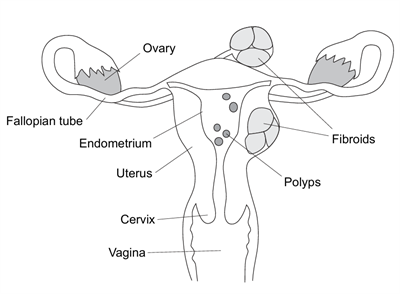
Endometrial Polypectomy is a procedure performed while you are awake. You may have some local anaesthetic injected into the cervix if needed.
A small telescope called a hysteroscope can then be passed through the vagina and into your womb. A sterile saline solution is used to distend the uterus. A device is passed down the Hysteroscope and the polyp or fibroid can then be removed. Period type pain or cramps may be experienced while the procedure is being carried out.
What are the risks?
There are risks with any procedure. Potential complications can include: bleeding, infection, perforation of the womb. These will be discussed with you when you sign the consent form.
What to expect before the procedure?
You may need medication to make you feel more comfortable one hour before. Your ability to drive safely may be impaired following this medication, so we advise that you do not drive home from this appointment. Your clinician will advise you if you will require premedication.
What can I expect after the procedure?
After the procedure you may need to rest in our recovery room until you feel you are ready to go home.
You may experience pain similar to period pain after the procedure. After the local anaesthetic wears off we recommend that you take over the counter pain medication like paracetamol or ibuprofen as per instructions on the pack. You may have a heavy vaginal bleeding immediately after the procedure which may be watery due to the saline solution used during the procedure. The bleeding is usually mild and should settle.
We advise you to use sanitary towels instead of tampons while you are bleeding to reduce the risk of an infection. Avoid sexual intercourse for approximately a week or until the bleeding/discharge stops. We recommend you shower rather than bath whilst you experience vaginal bleeding or a discharge.
If you feel unwell or have worsening pelvic pain that is not relieved by pain medication or if you experience vomiting , nausea, dizziness, a smelly offensive greenish vaginal discharge you should call your GP immediately.
More information
If you have any more questions about your treatment, phone our clinic on (01604) 545427 option 5, Monday to Friday 9.00am to 5.00pm. Outside of these hours, contact Spencer Ward on (01604) 544610.
Other sources of information:
NHS choices: the UKs biggest health website, certified as a reliable source of health information.
Useful Websites
NHS
www.nhs.uk
Northampton General Hospital
www.northamptongeneral.nhs.uk
Other information
Northampton General Hospital operates a smoke-free policy. This means that smoking is not allowed anywhere on the Trust site, this includes all buildings, grounds and car parks.
Leaflets, information, advice and support on giving up smoking and on nicotine replacement therapy are available from the Stop Smoking helpline on 0845 6013116, the free national helpline on 0300 123 1044, e-mail: smokefree@nhft.nhs.uk and pharmacies.
Car parking at Northampton General Hospital is extremely limited and it is essential to arrive early, allowing ample time for parking. Alternatively, you may find it more convenient to be dropped off and collected.
This information can be provided in other languages and formats upon request including Braille, audio cassette and CD. Please contact (01604) 523442 or the Patient Advice & Liaison Service (PALS) on (01604) 545784, email: ngh-tr.pals@nhs.net.
Updated: July 2019
NGV2130