Introduction
We hope the following information will be helpful to you. If you have any questions, please do not hesitate to contact your consultant’s secretary who will be happy to help you.
What is a prolapse?
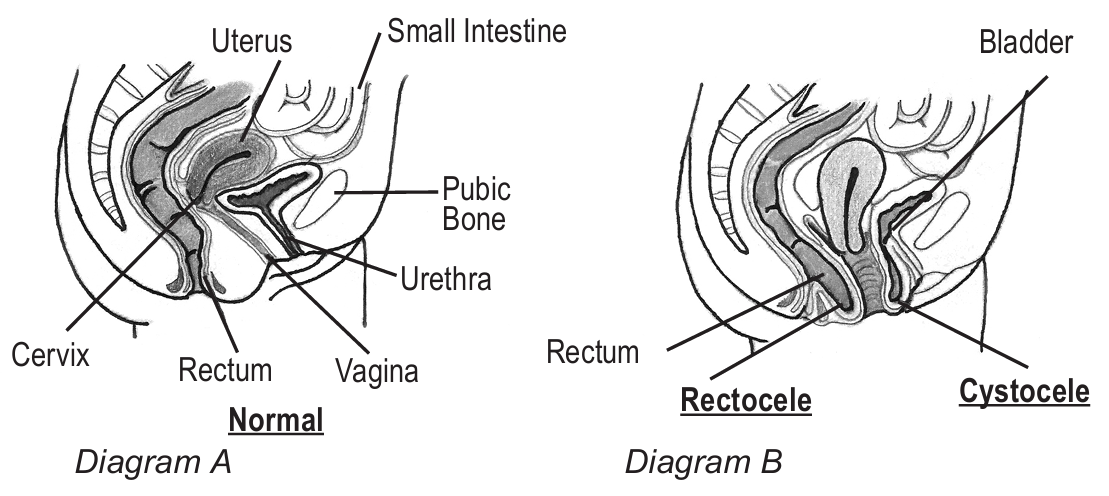
A prolapse is a bulge in the wall of the vagina. It is caused by weakness of the support structure (known as fascia ligaments and muscles) around the vagina. There are different types of prolapse.
-
An Anterior prolapse occurs when the supporting tissue between the vagina and bladder become weakened. This is when bladder drops into the vagina. (Diagram B)
-
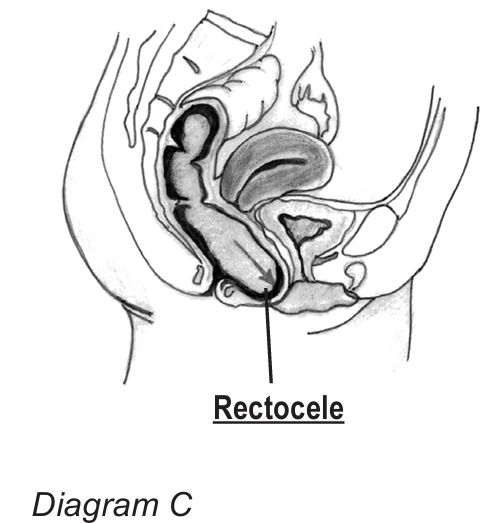
A Posterior prolapse occurs when the supporting tissue between the vagina and the bowels become weakened. (Diagram C)
-
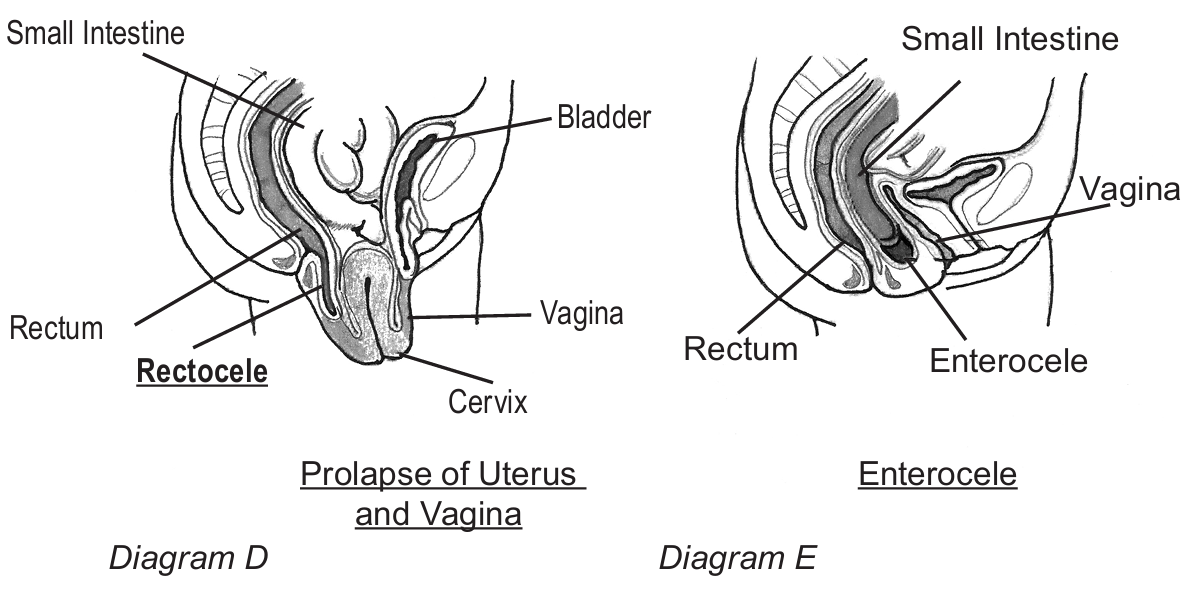
A uterine prolapse occurs when the womb (the uterus) moves down from its normal place into the vagina and pelvis. (Diagram D)
-
If you have had a hysterectomy (operation to remove your womb) in the past, there is also risk of developing a vault prolapse. This is where the top of the vaginal wall also begins to drop downwards. You may have one, or a combination of these prolapse. (Diagram E)
What causes prolapse?
A prolapse is usually caused by childbirth. However it can occur in women who have never been pregnant. Prolapse is usually noticed after the menopause (50-52 years of age), when oestrogen levels are low. Other related issues like long term constipation, doing a job which involves strenuous activity, being overweight, high impact exercise, smoking and having a long term cough can make the problem more noticeable earlier.
Why do I need a prolapse repair?
A prolapse can cause the following problems:
-
A ‘sensation of something coming down’.
-
The feeling of having not fully emptied your bladder or bowel.
-
The need to press on the back wall of the vagina to empty bowel completely.
-
A bulge in the vagina, which can cause discomfort when having sex and difficulty keeping a tampon in.
What are the other options?
There are other nonsurgical options available to treat prolapse.
-
Do nothing, if it is not painful or bothering you.
-
You may choose to try pelvic floor exercise under supervision of a specialist physiotherapist or a nurse specialist. This may control your symptoms.
-
You may choose to have a vaginal pessary fitted. Pessaries can lift the prolapse up, but will not repair the prolapse.
You are required to get the pessary checked approximately every 4 to 6 months, sometimes more and sometimes less often.
If you are interested in any of these options you can talk to your doctor or nurse about it to know whether it is an appropriate option for you. You may be taught how to remove and replace the ring yourself if you wish.
What are the benefits of having a prolapse repair?
The aim of the surgery is to restore the supports for the vagina, bladder and bowel. The surgery is primarily aimed to improve your symptoms.
What type of surgery will I have?
The management of prolapse may involve one or a combination of the following procedures:
-
Anterior Repair (Repair of the front wall of the vagina)
-
Posterior Repair (Repair of the back wall of the vagina)
-
Vaginal Hysterectomy (Removal of womb through the vagina)
-
Sacrospinus Fixation (Suspension of the vagina)
How is the operation performed?
Anterior & Posterior Repair
A cut is made through the lining at the front (anterior) and/ or back (posterior) of the vagina. The fascia supporting the bladder and/ or rectum are shortened with stitches. This repairs the weakness returning the bladder and rectum to their original position. The bulging part of the vagina is cut off and closed with dissolvable stitches.
Vaginal Hysterectomy
A cut is made at the top of the vagina, and the uterus and cervix is removed leaving the fallopian tubes and ovaries behind. This allows you to have a natural menopause if you are still having periods. There is no abdominal scar. The top of the vagina is the sewn up with dissolvable stitches where the incision was made.
Sacrospinous Fixation
The procedure involves making a cut through the lining at the back wall of the vagina. The top of vagina or the cervix is pulled up and fixed to a strong ligament at the back of the pelvis called the Sacrospinous ligament.
Prolapse repair is performed either under spinal or general anaesthetic. The Anaesthetist will advise on the best type of anaesthetic for you. You will see the anaesthetist on the day of the surgery. If you have any specific questions you can contact your surgeon and ask further questions.
Preoperative assessment
You will be asked to complete an online preoperative assessment and only contacted if there is any information of concern relevant to your surgery.
You will usually be admitted to hospital on the day of the operation. You will be asked to sign a consent form before the operation. Please ask any questions that you wish. A nurse will carry out a safety checklist ensuring we have the correct details about you.
Once you are on the waiting list
When you are placed on the waiting list we do try to aim to arrange your admission as soon as possible. You will be contacted by the consultant’s secretary at least 4 – 6 weeks prior to surgery. If you have said that you could be available to take a short notice admission you may be contacted with only a few days notice. Should you find that you book a holiday or have work commitments please contact the consultant’s secretary with your dates. If you require any further information regarding your operation procedure or have any other queries please contact your consultant’s secretary.
What are the risks with the procedure?
With all operations there are some risks.
-
Excessive bleeding. Occasionally you may require blood transfusion.
-
Infection
-
Allergic reaction to drugs or anaesthetic
-
Buttock pain that may last for a few weeks and occasionally longer
-
Recurrence of prolapse
Serious complications such as damage to the bowel or bladder are fortunately rare. Another rare but serious complication is thrombosis (blood clot) in the veins.
You will be given antibiotics to help reduce the risk of an infection. You will also be given heparin injections and stockings to reduce the risk of thrombosis.
Common but minor complications are raised temperature and temporary difficulty emptying the bladder. If you are unable to pass urine, you may be discharged with a urinary catheter with a valve attached to it, or you may be taught how to empty your bladder by introducing a small catheter in the bladder by yourself (Intermittent self catheterisation). In either of these cases we will support you with regular phone calls to review your progress. If you go home with the urinary catheter, you will be asked to come back to the hospital to have it removed.
At the end of the operation
When you wake up from the anaesthetic you will be in the recovery area. You will be given pain relief in the form of strong painkillers or injections. Anti-sickness injections will be given if needed. The following equipment may be attached to you:
-
Oxygen mask: You will usually be given oxygen for about four hours.
-
Drip or intravenous line: This is a fine tube inserted in the back of your hand or arm to give you fluids so that you do not become dehydrated.
-
Catheter: You will have a tube in your bladder to drain urine. It will usually be removed after 24 hours.
-
Vaginal pack: You may have gauze dressing in the vagina. This is usually removed on the following day.
Postoperative Recovery
Recovery exercises:
For the first few days after your operation it is important to perform ‘deep breathing exercises’. This is to try to help prevent a chest infection and involves taking deep breaths slowly in and out, to improve the flow of oxygen. Try to do these five times every hour. To help prevent circulatory problems try not to cross your legs in bed but move your feet up and down at the ankles, and circle them round and round. Try to do these exercises up to 10 times every hour until you are mobile.
Fluids and diet:
You will be offered small drinks of water after your operation.
Further fluids and diet will be offered as you recover.
Hygiene:
On the day after your operation you should be able to have a wash in the bathroom. Following this a shower can be taken daily but soaking in a bath should be avoided.
Bowels:
You may not have a bowel action for the first few days, this is quite normal. You will be given some suppositories to help if needed. A diet rich in fibre may help. You will be advised to take appropriate laxatives for few weeks to help with your bowels. Drink plenty of fluids, trying to avoid to much tea and coffee. Gentle mobilisation will help the bowels to work.
Prevention of blood clot:
During your stay in the hospital you will be less mobile. You will be given an injection of heparin to prevent complications with blood clot formation in your calf. Regular movement of you leg muscles (flexing your feet and circling you ankles) will help keep the blood moving.
Going Home
You will usually be discharged approximately two days following your operation.
Housework and exercise:
At first, rest when you feel tired, but it is important to walk around the house to try to prevent complications with blood clotting. Gradually increase the distance that you walk outside as you improve. For the first two weeks you should not lift anything heavier than a kettle half full of water. Avoid vacuuming and ironing for four to six weeks. You are at risk of developing further prolapse if you do any heavy lifting. Swimming is possible six to eight weeks after surgery. More strenuous exercise such as gym work should be avoided for three months.
Vaginal bleeding/discharge:
It is possible to have some bleeding or discharge for up to six weeks following surgery. The discharge may contain threads as the stitches dissolve. If the discharge becomes offensive or smelly, see your GP as you may have an infection. It is best to avoid tampons. Use pads to reduce the risk of infection.
Intercourse:
We advise you to wait five to six weeks before having sex. This is to allow the wound inside the vagina to heal. If you feel any discomfort a lubricant gel may be helpful.
Bowels:
Try to avoid constipation by eating plenty of fruit, vegetables and wholemeal bread. Drink plenty.
Smears:
If the operation involved removal of the womb it is unlikely that you will need any further smears. Talk to your doctor about it before discharge if you have any doubt. You may need a “vault smear” one year after your surgery to check for cervical cells.
Driving:
You should not drive for approximately six weeks, to avoid any problems with your recovery. Also you may be unable to perform an emergency stop, so check with your insurance company.
Time off work:
Take a minimum of four to six weeks off work, if you have a heavy job you may need eight to twelve weeks off. We would encourage you to get back to normal activity as soon as you are able. Discuss this with your consultant/GP.
When to seek medical advice
-
If you develop a temperature
-
Burning or stinging when passing urine
-
Heavy or smelly vaginal discharge or bleeding which restarts
Follow up
You will have a follow up appointment in three months when you will be seen by a doctor or you may have telephone follow up to ensure all is well. In some cases we may ask you to have a follow up check up at your doctor’s surgery. In some cases you may have an earlier appointment if it is clinically required. This will be discussed with you prior to your discharge after your surgery. If you develop problems or require advice following discharge you should initially contact your GP.
Questions
If you have any Questions please write them down here. We will be happy to answer all your questions when you are admitted for your operation.
Useful Websites
NHS
www.nhs.uk
Northampton General Hospital
www.northamptongeneral.nhs.uk
Other information
Northampton General Hospital operates a smoke-free policy. This means that smoking is not allowed anywhere on the Trust site, this includes all buildings, grounds and car parks.
Leaflets, information, advice and support on giving up smoking and on nicotine replacement therapy are available from the Stop Smoking helpline on 0845 6013116, the free national helpline on 0300 123 1044, e-mail: smokefree@nhft.nhs.uk and pharmacies.
Car parking at Northampton General Hospital is extremely limited and it is essential to arrive early, allowing ample time for parking. Alternatively, you may find it more convenient to be dropped off and collected.
This information can be provided in other languages and formats upon request including Braille, audio cassette and CD. Please contact (01604) 523442 or the Patient Advice & Liaison Service (PALS) on (01604) 545784, email: ngh-tr.pals@nhs.net.
Updated: October 2023
NGV1548