Emissions from the production, use and disposal of medicines is a large emissions hotspot within acute trusts. Initial work focussed on the removal of desflurane, the most damaging of inhaled anaesthetic agents, which was removed from NHS formularies in 2024.
Both the inhalers and anaesthetic gases, including Entonox, are included in the NHS 2040 net zero target. Other prescribed medicines are included in the 2045 net zero target.
NGH has a dedicated team of pharmacists and an aseptic unit within the Trust.
Information relating to the environmental impact of inhalers has been difficult to obtain until recently, therefore 2024/25 will be the baseline year for any reduction targets.
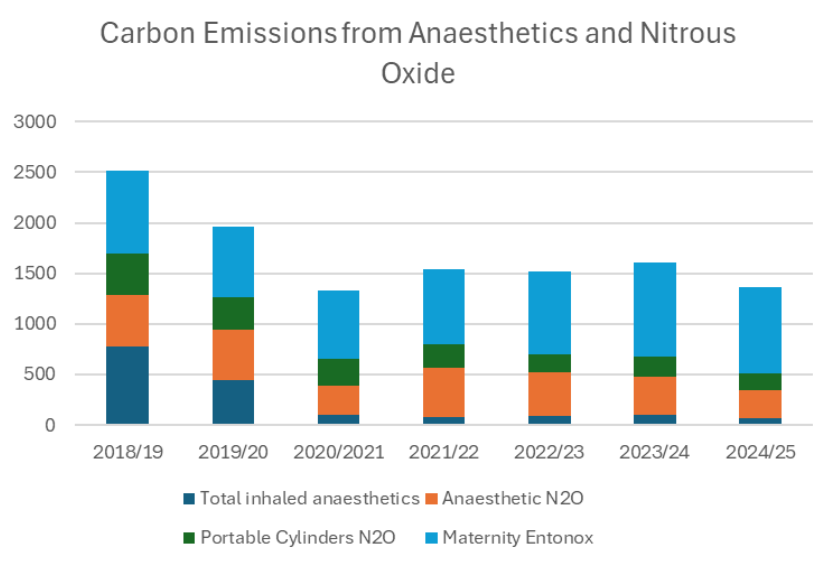
Where we are now:
NGH has been working to reduce the environmental impact of anaesthetics since 2018; progress has been reported annually. Desflurane was removed one year ahead of national targets.
The removal of desflurane from the Trust reduced anaesthetic related emissions by 695 tonnes CO2e in five years. Another high emitter of greenhouse gases is nitrous oxide used as an anaesthetic in theatres and for pain relief in the form of Entonox in maternity and areas such as the Emergency Department. Work has shown that there is significant leakage from nitrous oxide manifolds serving theatres no matter the diligence of the Estates testing regime. The Royal College of Anaesthetists endorsed the removal of nitrous oxide manifolds within theatres. NGH signed off the replacement of piped nitrous oxide with bottled gas which it expects will reduce the emissions by a minimum of 200 tonnes CO2e each year. This was completed in the final quarter of 2024/25 and has already positively impacted emissions.
Penthrox, which can be used in some instances for pain relief in place of bottled Entonox, was added to the ED and Gynaecology formulary in 2025.
An area of high priority is the switch from IV (intravenous) to oral medication, particularly for paracetamol and some antibiotics. Not only does this reduce waste, costs and carbon emissions, it can also save significant amounts of staff time, and reduces the potential for patient infections. Work has been started to prescribe oral paracetamol for pre-operative patients, and the Trust has significantly reduced its prescription of IV antibiotics. This latter project has shown emission reductions of over 200 tonnes CO2e are possible across NGH and KGH.
Projects targeting medicine waste have been completed in two wards. This work has reviewed the impact of not prescribing additional drugs if they are already being prescribed to the patient in the community. Initial review on one ward has reduced costs by £4,000 and carbon emissions by 1 tonne per month.
Three pharmacists completed intensive Leadership for Sustainable Healthcare course and the department has representatives on the Sustainable Surgery and Sustainable Development Committee.
Our aims are to:
Medicines Action Plan
|
| Action Review the options to extend the shelf life of medicines from the aseptic unit and review the ability to reuse returned medicines |
Financial Investment Low |
When 2027 |
Responsible Department Pharmacy |
| Action Extend projects relating to patients own drugs to other wards |
Financial Investment Low |
When 2026 |
Responsible Department Pharmacy |
| Action Calculate carbon emissions from Intravenous vs oral medicines |
Financial Investment Low |
When 2026 |
Responsible Department Pharmacy |
| Action Extend and capture savings from Intravenous to oral antibiotics |
Financial Investment Low |
When 2027 |
Responsible Department Pharmacy |
| Action Extend and calculate savings from Intravenous to oral paracetamol |
Financial Investment Low |
When 2027 |
Responsible Department Pharmacy |
| Action Introduce insulin pen recycling |
Financial Investment Low |
When 2025 |
Responsible Department Pharmacy |
| Action Establish a green group within Pharmacy |
Financial Investment Low |
When 2025 |
Responsible Department Pharmacy |
| Action Use pharmacy knowledge to educate staff and patients regarding lower environmental impact options |
Financial Investment Low |
When 2026 |
Responsible Department Pharmacy |
| Action Review options for calculating carbon emissions from medicines beyond anaesthetics and inhalers |
Financial Investment Low |
When 2027 |
Responsible Department Pharmacy |
| Action Include reporting of medicines wastage reduction projects into Sustainable Development Committee |
Financial Investment Low |
When 2025 |
Responsible Department Pharmacy
|
Measurement
Annual reporting of anaesthetic gases and Entonox from Pharmacy orders
Annual reporting of inhaler data from
Pharmacy Reduction in medicines wastage from
Pharmacy IV prescriptions from Pharmacy