Video call helps save patient with rare brain stem stroke
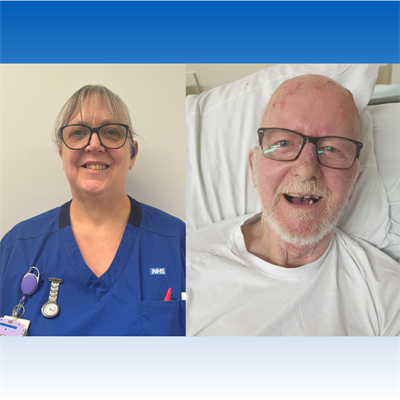
Rachael Day (L), lead stroke specialist nurse who took the critical call Richard Hughes (R) from Kettering
A new way to triage patients via video call has helped save the life of a man experiencing a rare stroke, even though the service was not due to be launched for a further three weeks.
The University Hospitals of Northamptonshire (UHN)’s new Pre-Hospital Video Triage (PHVT), which enables specialist stroke nurses to assess patients via video call prior to arrival in hospital, officially went live on February 9.
However, on January 22, Rachael Day, lead stroke specialist nurse for Northampton General Hospital, answered what she thought was a test call and found herself speaking with paramedics who had been called out to Richard Hughes from Kettering.
Richard was experiencing double vision and a headache after describing something “going ping” in his head but was not presenting with typical stroke symptoms such as slurred speech, drooped face, or arm weakness.
During the video call, Rachael was able to speak to Richard and realised that one of his eyes was slightly turned out and he could not look side-to-side.
She said: “Richard had full range of movement and was talking quite clearly but as soon as I spotted the issues with his eye, I realised this was potentially a very serious stroke and arranged for him to be seen immediately at our specialist stroke unit in Northampton General Hospital.”
Richard was unconscious by the time he arrived, but thanks to the initial video triage, he was taken immediately for a CT scan. The scan revealed a blood clot in his basilar artery, which is vital for regulating heart rate and supplying oxygen to the brain. Basilar artery strokes are rare, accounting for around one percent of all strokes, and can be fatal in up to 95 percent of cases if not treated swiftly.
Half an hour after he had arrived, Richard was transferred to John Radcliffe Hospital, Oxford, for emergency surgery to remove the clot, returning to Northampton General Hospital shortly afterwards for rehabilitation.
Richard said: “I don’t remember much about the day I fell ill, but I am certain I would have died if Rachael hadn’t taken that video call. She and the team acted so quickly to make sure I was seen and treated. I feel very lucky to be here.”
Richard’s wife, Jane, 66, added: “Before I even had a chance to sit down in the hospital waiting room, Richard had been scanned and was being transferred to Oxford. It was just so slick. Everybody was so professional, organised, informative and kind. We want to thank everyone involved from the bottom of our hearts.”
Richard spent three months in Northampton General Hospital, celebrating his 80th birthday while there. Following discharge on 22 April, he continues to receive support to walk and speak, and looks forward to celebrating his milestone birthday properly.
Northampton General Hospital is the fourth acute stroke unit in the East Midlands to start using PHVT. Since its launch, the service has been used to triage over 180 patients across the county.
Rachael said: “PHVT allows us to assess suspected stroke patients faster and make quicker decisions based on what we see. When time is of the essence, these calls help ensure patients receive the right care at the right time.
“I am grateful I received that video call because it meant we were able to act quickly, diagnose the issue, and administer life-saving thrombolysis treatment to reduce the clot and restore blood flow, before transferring him to Oxford.
“We are delighted that Richard has now returned home to continue his recovery, and we wish him all the very best for the future.”
Posted on Wednesday 6th May 2026